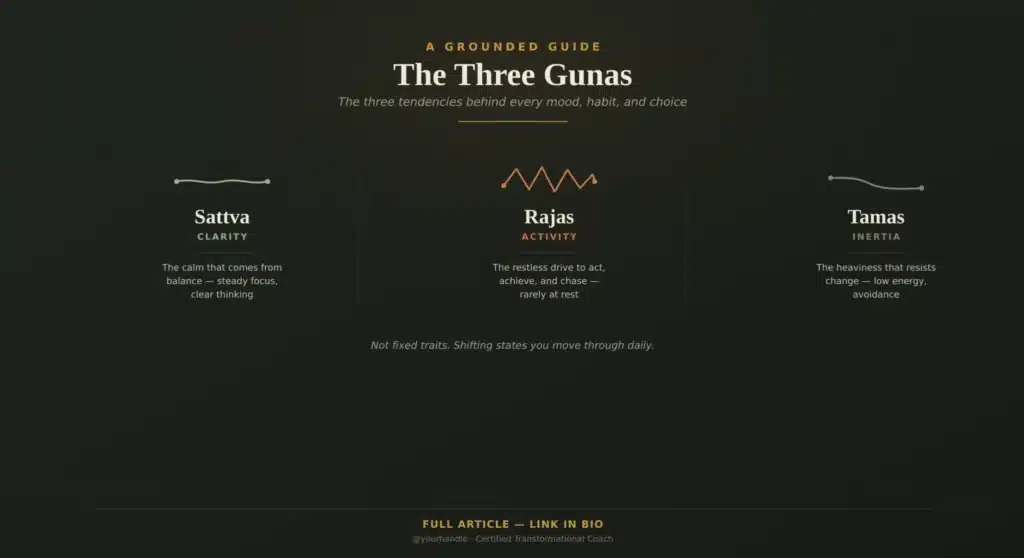
If you’ve spent any time around yoga, Ayurveda, or Indian philosophy, you’ve probably come across the word “guna.” It sounds abstract at first — almost too philosophical to be useful. But once you understand the three gunas, you start seeing them everywhere: in your energy levels, your relationships, your work habits, even in what you eat.
The three gunas — satva, rajas, and tamas — are not mystical forces outside of you. They are three qualities of energy that exist within everyone, all the time, in different proportions. Understanding them isn’t about achieving some perfect spiritual state. It’s about recognizing which quality is driving your behavior at any given moment, so you can make better choices.
This article breaks down what each guna actually means, how to recognize them in daily life, and how to work with them — without the vague, overly mystical language that usually surrounds this topic.
What Are the Gunas? A Quick Background
The concept of the three gunas comes from Samkhya philosophy, one of the oldest schools of thought in Indian tradition, and it’s referenced extensively in texts like the Bhagavad Gita. According to this framework, everything in nature — including your mind — is made up of these three qualities in constantly shifting proportions.
Think of the gunas less like personality types and more like weather patterns. You don’t “become” satvic or rajasic permanently. Instead, your inner state moves between these three qualities depending on your habits, environment, sleep, food, relationships, and mental patterns.
Let’s look at each one individually.
Satva: Clarity, Balance, and Calm Focus
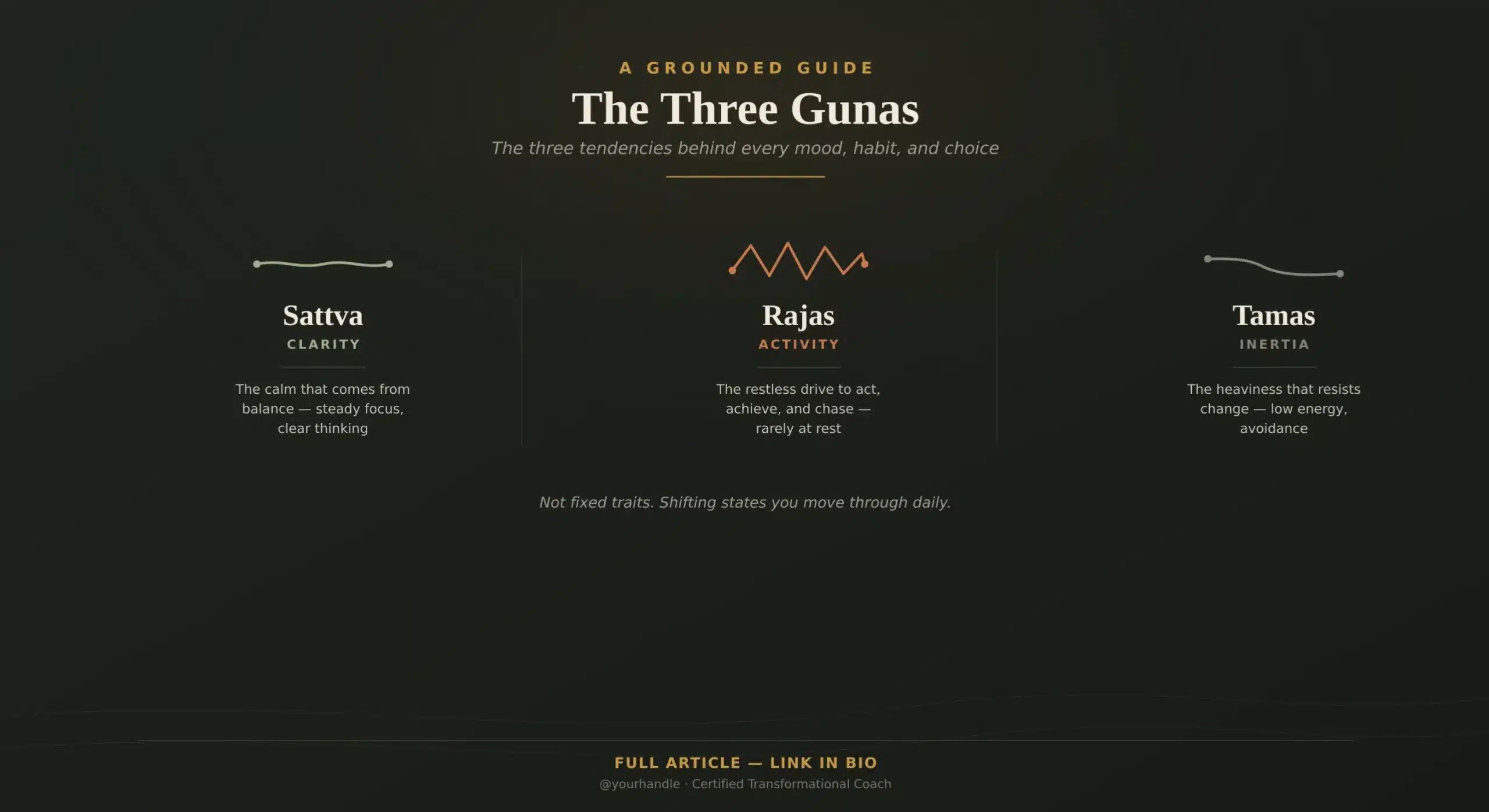
Satva is the quality of clarity, harmony, and balanced awareness. When satva is dominant, you feel calm but alert — not sleepy, not restless. Decisions feel easier because your mind isn’t clouded by anxiety or fog.
Signs satva is dominant in you right now:
- You feel calm and focused without forcing it
- Your thoughts are clear rather than scattered
- You make decisions from a grounded place, not from fear or urgency
- You feel content without needing constant stimulation
- Your energy feels steady throughout the day
Satva isn’t about being passive or emotionless. It’s about having enough inner stillness that you can respond to situations thoughtfully instead of reacting impulsively. People often mistake satva for suppressing emotion — it’s actually the opposite. Satva gives you the clarity to feel your emotions fully without being hijacked by them.
What increases satva: Adequate sleep, nourishing food, time in nature, honest self-reflection, meaningful work, and relationships built on mutual respect.
Rajas: Action, Ambition, and Restlessness
Rajas is the quality of movement, drive, and desire. It’s the energy behind ambition, ideas, embarking on new projects, and getting things done. In moderation, rajas is essential — without it, nothing would ever get built or achieved.
But rajas has a shadow side. When it becomes excessive or unbalanced, it turns into restlessness, anxiety, competitiveness, and burnout. You know rajas has taken over when you can’t sit still, when your mind is constantly racing toward the next goal, or when your sense of self-worth becomes tied to constant achievement.
Signs rajas is dominant in you right now:
- You feel driven, but also restless or anxious
- You struggle to slow down or rest without guilt
- Your decisions are often fueled by urgency, fear of missing out, or a need to prove something
- You feel competitive or comparison-driven
- Your mind jumps from one task to the next without settling
Rajas isn’t “bad.” Most modern professional life runs on rajasic energy — deadlines, hustle, growth targets. The problem isn’t rajas itself; it’s rajas without any satva to balance it. That’s when ambition turns into exhaustion, and drive turns into anxiety.
What increases rajas: Excessive stimulation (constant notifications, multitasking), comparison (social media), stimulants like caffeine in excess, high-pressure environments, and chronic overcommitment.
Tamas: Inertia, Heaviness, and Avoidance
Tamas is the quality of inertia, dullness, and resistance to change. It shows up as procrastination, avoidance, lethargy, confusion, and a general sense of being “stuck.” Where rajas pushes you forward too fast, tamas holds you back entirely.
Tamas often gets labeled as purely negative, but it does serve a purpose — rest, integration, and stillness are necessary parts of any cycle. The issue arises when tamas becomes chronic: when rest turns into avoidance, and stillness turns into stagnation.
Signs tamas is dominant in you right now:
- You feel heavy, foggy, or unmotivated
- You avoid decisions or conversations you know you need to have
- You feel stuck in patterns you know aren’t serving you, but don’t act to change them
- Your thinking feels dull or confused rather than clear
- You isolate or numb out instead of engaging
Tamas often gets mistaken for laziness or weak willpower, but it’s more accurate to think of it as depleted energy that hasn’t been replenished properly — often because rajas ran unchecked for too long, and the body or mind eventually shut down as a form of protection.
What increases tamas: Poor sleep, ultra-processed food, prolonged isolation, unresolved emotional avoidance, and environments that lack stimulation or purpose.
Why Understanding the Gunas Actually Matters
Here’s where this stops being philosophy and becomes practical. Most people assume their mood or behavior is just “who they are” — I’m a procrastinator, I’m an anxious person, I’m indecisive. But when you understand the gunas, you realize these aren’t fixed identities. They’re temporary states, shaped by conditions you can actually influence.
If you’re stuck in tamas, the answer isn’t to force yourself into rajasic hustle — that usually backfires into burnout. The more effective move is to gently increase satva first: better sleep, lighter food, small honest actions — which naturally lifts you out of inertia.
If you’re stuck in rajas, the answer isn’t to crash into tamas through burnout or avoidance. It’s to intentionally build in satvic practices — stillness, reflection, boundaries — so the drive becomes sustainable instead of depleting.
This reframe changes how you approach personal growth. Instead of judging yourself for being “unmotivated” or “anxious,” you can ask a more useful question: which guna is dominant right now, and what would help me shift toward balance?
A Simple Way to Apply This in Daily Life
You don’t need to overhaul your life to work with the gunas. Start with observation:
- Notice, don’t judge. At different points in your day, simply notice: does this feel satvic, rajasic, or tamasic? No need to fix it immediately — awareness is the first step.
- Match the antidote to the state. Feeling tamasic? Introduce gentle movement or a small satvic action, not a huge rajasic push. Feeling overly rajasic? Introduce stillness, not more stimulation.
- Track your patterns, not just your moods. Over a week, you’ll likely notice your gunas shift with sleep, food, screen time, and the people you’re around. This is more useful data than trying to “fix your mindset” in the abstract.
The Real Goal: Balance, Not Permanent Satva
A common misunderstanding is that the spiritual goal is to live in constant satva and eliminate rajas and tamas entirely. That’s not realistic, and honestly, it’s not even the point. All three gunas serve a function — rajas drives creation and action, tamas allows for rest and integration, and satva provides the clarity to navigate both without losing yourself.
The real work isn’t becoming a permanently calm, detached person. It’s building enough self-awareness to notice which guna is running the show, and enough self-trust to gently guide yourself back toward balance when you’ve drifted too far into restlessness or inertia.
That’s not a one-time achievement. It’s an ongoing practice — one rooted less in spiritual perfection, and more in honest self-observation.
If this framework resonated with you and you want support applying it to your own patterns, Book a Free Clarity Call and I’ll walk you through how I work with clients one-on-one.