Learn about Pretas as per Garuda Purana
In Hindu tradition, few figures capture the feeling of being “stuck” quite as literally as the preta. Usually translated as “ghost” or “wandering spirit,” a preta isn’t simply a spooky figure from folklore — it’s a symbol with real psychological weight, and one that still has something to say to anyone who’s ever felt trapped between an old chapter of life and a new one they can’t quite step into.
This article looks at what a preta actually is according to Hindu scripture, why the concept exists, and — more usefully — what it can teach us about grief, attachment, and the particular kind of stuckness that has nothing to do with ghosts at all.
The Meaning of Preta in Hindu Scripture
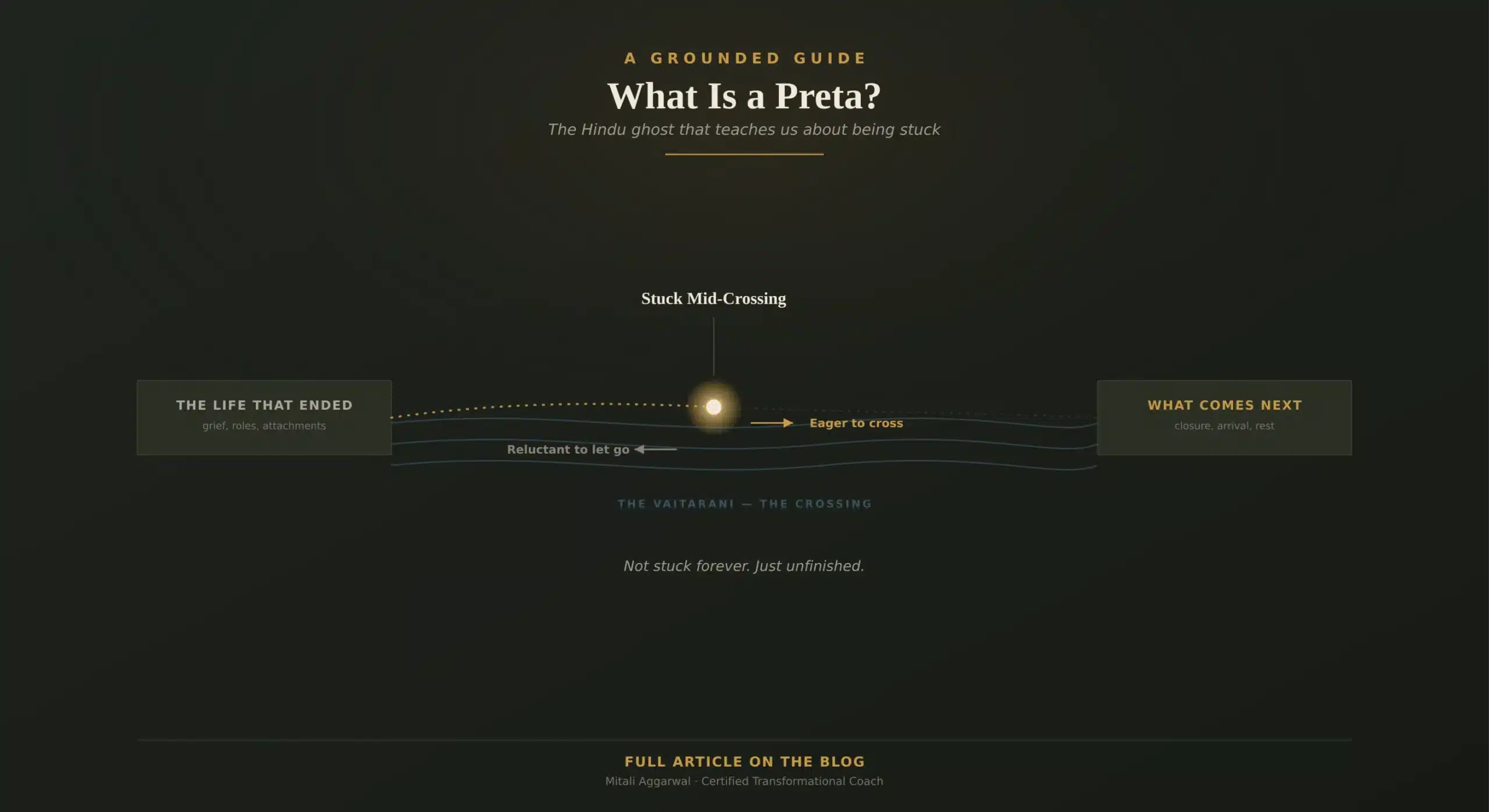
According to texts like the Garuda Purana, a preta is the spirit of a person who has died but has not yet completed the journey to the next realm — the realm of Yama, lord of the dead, reached only after crossing the mythical river Vaitarani. Rather than making that crossing, the preta remains bound to the earth: hovering near the place of death, haunting a cremation ground, or lingering close to family and familiar places, unable to fully let go of the life it just left.
The imagery associated with pretas is vivid and specific. They’re often described as taking shelter in banyan trees, hanging upside down among the branches like bats roosting in the aerial roots — a tree that, fittingly, is also associated in the tradition with ash, endings, and the boundary between life and death. Wandering ancestral spirits are described as being famished and desperate, capable of frightening the living, but also, in their own way, pitiable: creatures caught in a hunger that ordinary food can never satisfy, because what they’re actually starving for is completion.
The reasons a soul becomes a preta vary across the tradition, but they tend to circle a common theme: incompletion. A death that came too suddenly for proper rites to be performed. A life ended with unresolved anger, craving, or attachment. Funeral rituals that were skipped, delayed, or done incorrectly. In each case, something that needed to be finished simply wasn’t — and the preta is what’s left hovering in that gap.
Traditional funeral rites in Hindu practice — including the offering of rice balls (pinda) and water over a period of days, along with chants and songs specifically meant to guide and comfort the departed spirit — exist to ease this transition, symbolically giving the spirit what it needs to complete the journey rather than remain caught in between. In sacred sites like Kashi, this attentiveness to the dead runs deep enough that resident spirits of the cremation grounds are treated almost like part of the community — even said to be included when Shiva himself, in some tellings, joins in the city’s Holi celebrations, extending comfort to ghosts as well as the living.
Two Kinds of Pretas: The Eager and the Reluctant
One detail from the tradition is especially useful once you start applying the preta concept to real life: not all pretas are the same. Folk tradition draws a distinction between spirits who are eager to complete their journey and cross over, and those who are reluctant — uncertain, resistant, or simply unwilling to let go, even when the way forward is open to them.
This distinction maps almost perfectly onto how people actually relate to their own unfinished business. Some people, once they name what’s unresolved, move through it relatively quickly — they were, in a sense, already eager to cross over, just missing the right prompt or process. Others resist the process itself, circling the same grief or attachment repeatedly, even when a path through it is available. Recognizing which kind of “reluctant ghost” energy you’re bringing to a given situation is often more useful than any amount of general advice about “letting go” — because eagerness and reluctance call for different approaches entirely.
Why the Preta Doesn’t Just “Move On”
What makes the preta such a compelling figure isn’t the ghost story — it’s the mechanism behind it. A preta isn’t punished or trapped by an outside force. It’s held in place by its own unfinished attachment: to a person, a possession, a grievance, or simply to life as it used to be.
This is worth sitting with, because it maps onto something almost everyone recognizes without needing any belief in ghosts at all. Grief that never got expressed. A relationship that ended without a real conversation. A version of yourself you never quite said goodbye to. None of these keep you “stuck” because some external force is holding you there — they keep you stuck because something inside you hasn’t finished processing yet.
The Preta as a Metaphor for Emotional Stuckness
You don’t have to take the preta literally to find it useful. Strip away the supernatural framing, and the preta becomes a strikingly accurate metaphor for a very ordinary human experience: staying attached to something the moment has already passed.
A few modern equivalents of “preta energy,” so to speak:
- Unprocessed grief. Organizing your life around someone or something that’s gone, without ever consciously working through the loss.
- Unfinished conversations. Carrying resentment or longing toward someone you never said the real thing to — replaying it mentally instead of letting it close.
- Identity attachment. Holding onto a former role or chapter of life long after it’s ended, because letting go feels like losing yourself entirely.
- Avoided rituals of closure. Skipping the small, deliberate acts that mark an ending, which can leave a situation feeling unfinished indefinitely.
In each case, the “hungry ghost” quality of a preta shows up as a kind of restless craving: wanting resolution, but circling the same unresolved point instead of moving through it.
What Helps a Preta “Cross Over” — And What Helps You
The tradition’s answer to a preta’s suffering isn’t ignoring it or waiting for it to fade on its own. It’s ritual — a deliberate, structured act of completion. Offerings are made. Words are spoken. A process is followed through to its actual end, not left open-ended indefinitely.
The same principle holds up remarkably well outside the context of mythology. Emotional “unfinished business” rarely resolves simply by waiting long enough. It tends to need something more active:
- Naming what wasn’t finished. Grief, anger, or longing that was never consciously acknowledged has a way of running quietly in the background indefinitely. Naming it plainly is often the first real step toward completing it.
- Creating your own closure ritual. This doesn’t need to be religious. Writing an unsent letter, having the conversation you never had (even if only in a journal), or marking an ending with a deliberate, symbolic act can do real psychological work.
- Letting go of the craving for a different past. A preta’s suffering comes from wanting things to be otherwise. Similarly, a lot of human stuckness comes from wishing a situation had gone differently rather than accepting it as it actually was and building forward from there.
- Seeking support rather than staying isolated. In the tradition, the living perform rituals on behalf of the dead — the preta doesn’t complete the journey alone. There’s a real parallel here: working through genuine stuckness is often easier, and faster, with support rather than in isolation.
Why This Matters Beyond Mythology
The preta isn’t just an interesting piece of scripture — it’s a strikingly precise description of what it feels like to be caught between an ending and a beginning, unable to fully arrive in either. Understanding the concept isn’t about adopting a belief system; it’s about recognizing a pattern that shows up in ordinary life far more often than most people realize.
If any part of this — the sense of circling the same unresolved point, the difficulty letting go of a chapter that’s already closed — feels familiar, that’s worth paying attention to. It’s usually a signal, not a flaw.
Ready to work through what’s keeping you stuck? If you recognize the “preta pattern” in your own life — unfinished grief, an unresolved chapter, an attachment you can’t quite release — a structured, supportive process can make the difference between circling it indefinitely and actually moving through it. Book a free clarity call to start working through it together.