Have you ever felt like your mind is a browser with fifty tabs open — and you can’t find the one you actually need? Between managing careers, nurturing relationships, chasing goals, and handling the everyday demands of life, our thoughts can easily become a tangled mess. Important ideas get buried. Priorities blur. And decision-making feels harder than it should be.
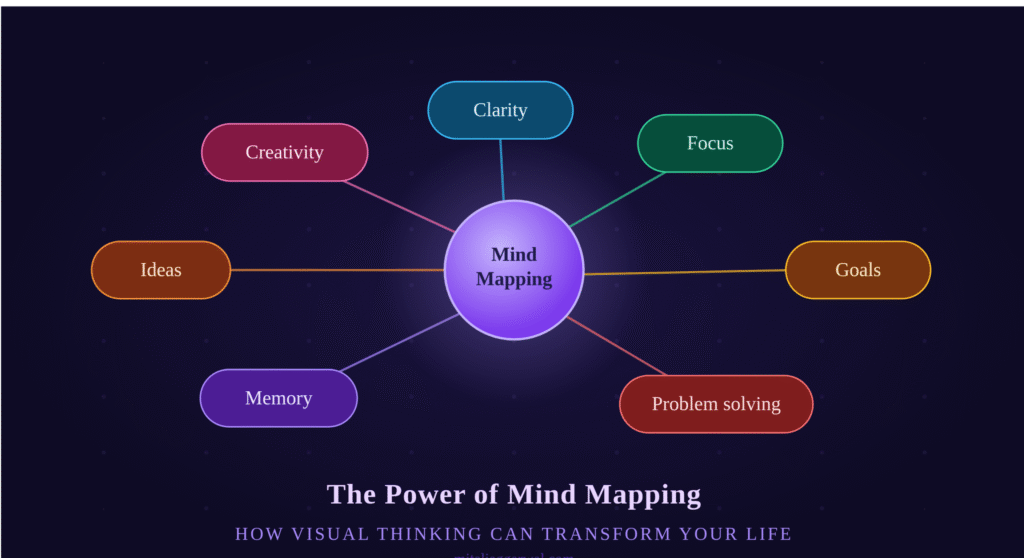
Mind mapping is a visual thinking technique that helps you cut through that mental noise. Instead of forcing your ideas into rigid lists or linear notes, a mind map lets your thoughts expand outward from a central idea — the way your brain actually works. The result is a clear, connected picture of everything in your head, laid out on a single page.
What is Mind Mapping?
A mind map is a diagram that starts with one central concept — placed in the middle of the page — and radiates outward into branches of related ideas, goals, or tasks. Each branch can then sprout smaller sub-branches, breaking big topics down into specific details or action steps. The structure mirrors how the human brain naturally forms associations: not in straight lines, but in clusters and connections.
For instance, if your central topic is “My Future Goals,” your main branches might look like this:
- Career
- Relationships
- Health
- Finances
- Personal Growth
- Travel
- Education
This simple but powerful structure lets you hold the big picture in mind while also drilling into the details — something a linear list simply cannot do.
Why Mind Mapping is so Effective
Mind mapping works because it bridges creativity and logic at the same time. Unlike traditional note-taking, which engages only the language centres of your brain, a mind map activates visual, spatial, and associative thinking simultaneously — making information easier to absorb, retain, and act on. Here are the key benefits:
1. Enhances Clarity of Thought
When you are overwhelmed by too many competing thoughts, a mind map helps you lay everything out and see the full picture at once. Faced with a difficult decision? Instead of turning options over endlessly in your head, you can map them out, compare them visually, and identify what truly matters — with far greater clarity and far less anxiety.
2. Boosts Creativity
Because mind maps are non-linear and free-form, they remove the mental block that comes with staring at a blank page. One idea spark another, and another after that. This is why writers, designers, entrepreneurs, and teachers use mind mapping to brainstorm — it creates a safe space for ideas to emerge without judgment or structure getting in the way.
3. Improves Memory and Learning
Research consistently shows that we retain information better when it is presented visually rather than as dense blocks of text. By combining keywords, colours, images, and spatial connections, a mind map creates multiple mental “hooks” for each idea — making it significantly easier to recall later, whether you’re studying for an exam or preparing for a presentation.
4. Helps with Goal Setting
Large goals can feel paralyzing precisely because they are large. A mind map breaks them into branches — each branch a category, each sub-branch an action step — making even the most ambitious goals feel manageable. You can track milestones, identify dependencies, and stay motivated by seeing the complete roadmap of where you are going and how you will get there.
5. Decreases Stress and Mental Clutter
There is something deeply relieving about getting your thoughts out of your head and onto paper. Mental clutter — the swirl of unfinished thoughts, forgotten tasks, and unresolved worries — is one of the leading causes of stress and poor sleep. A mind map externalises that clutter. Once it’s on the page, your brain can let go of the burden of holding it all and focus on what actually needs attention right now.
Areas of Life You Can Mind Map
One of the greatest strengths of mind mapping is its versatility — it works for virtually any domain of life. Here are some of the most impactful areas where mind mapping can create real, lasting change:
1. Relationships — With Others and Yourself
Healthy relationships require intention — and a mind map helps you bring that intention to the surface. Use it to explore:
- What you desire in relationships
- Communication improvements
- Family goals
- How to foster greater friendships
2. Career and Education
Whether you are climbing the corporate ladder, building a business, or returning to study, mind maps give your ambitions a clear, visual shape. Use them for:
- Career planning
- Skill development
- Business ideas
- Learning goals
- Time management
3. Money and Finances
Financial clarity is not just about numbers — it’s about mindset. A mind map helps you see your full financial picture and identify both your goals and the habits that will get you there. Map out your:
- Savings goals
- Income ideas
- Budget plans
- Financial habits
- Investment learning
4. Health and Lifestyle
Your body and your schedule are deeply connected. A mind map makes it easier to design a lifestyle that actually supports your wellbeing, not just one you aspire to. Use it to plan:
- Fitness routines
- Mental health goals
- Better work-life balance
- Plans for travel and recreation.
5. Emotional and Spiritual Wellbeing
This is perhaps the most powerful use of mind mapping — turning inward. When you map your inner world, you bring unconscious beliefs and values into the light, where they can be examined, understood, and transformed. Use it to reflect on:
- Personal values
- Emotional growth
- Confidence building
- Self-discipline
- Inner peace and mindful awareness
How to Create Your First Mind Map
You don’t need any special skills or expensive software to get started. All you need is a blank page — or a free tool like MindMeister, XMind, or even Canva — and a willingness to let your thoughts breathe.
Follow these five simple steps:
- Write your main topic in the middle of the page.
- Draw branches for categories.
- Include smaller branches for ideas, goals, or actions.
- Use keywords and short phrases rather than full sentences — brevity keeps the map scannable
- Add colours, symbols, or small drawings to different branches — this activates visual memory and makes the map more enjoyable to revisit
There is no single right or wrong way to build a mind map. The only rule is this: let your thoughts move freely. Perfection is not the goal — clarity is.
Conclusion
Mind mapping is far more than a productivity tool — it is a way of thinking that puts you back in the driver’s seat of your own life. Whether you want to strengthen your relationships, grow your career, take control of your finances, or simply quiet the noise in your mind, a mind map gives you the clarity to see what matters most and the structure to act on it. The future belongs not to those who think harder, but to those who learn to think better. Start with a blank page, a central idea, and one honest branch — and see where your mind takes you.
If you have liked to read this, then you might also like another post I recently shared: https://mitaliaggarwal.com/10-mind-expanding-questions-to-strengthen-brain-connections/
Book a free discovery call if you think I can offer you some assistance in figuring things out in your life right now: https://calendly.com/mitaliaggarwalr/30min